CHOOSEAgents & automation
Jev Decision Engine

amr@AmrTawfik160
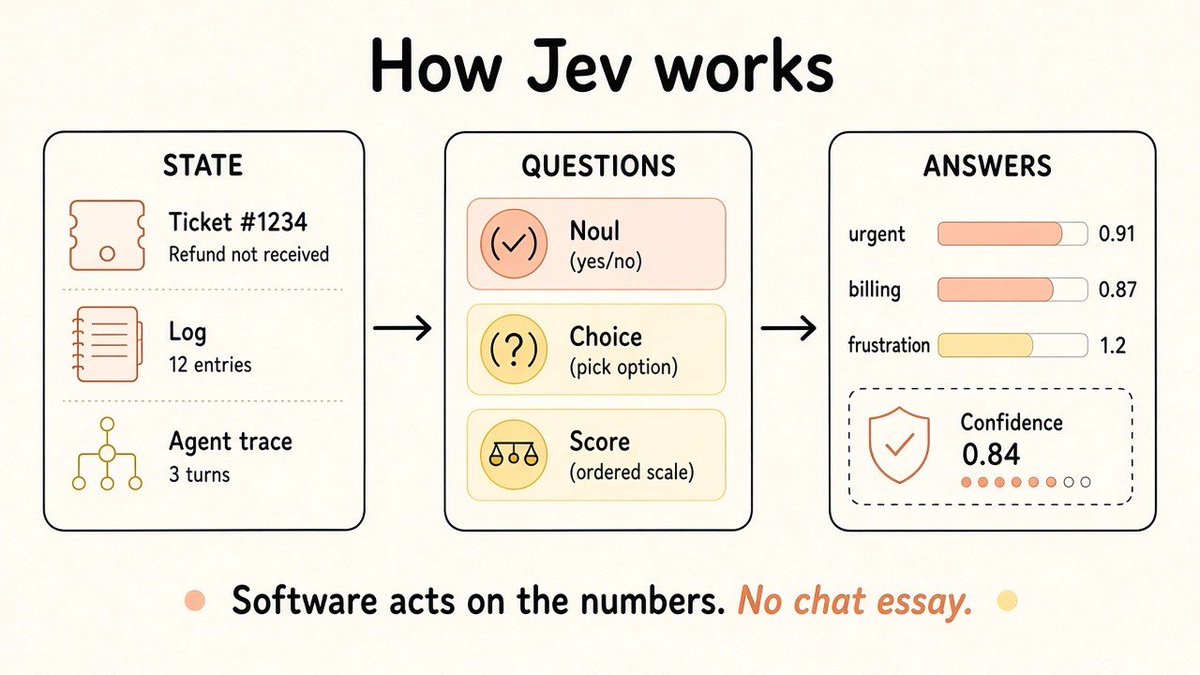


Jev is a system designed for making rapid, structured decisions by processing state inputs and answering typed questions with numerical outputs, enabling automated software actions without human-readable text generation.
SignalI watched one of my agents burn a frontier model just to decide which tool to call next that's most of the loop. not the clever writing. the boring choosing TypeSafe just shipped Jev for exactly that job.
Pattern↑ Jev AI decision making
I watched one of my agents burn a frontier model just to decide which tool to call next
that's most of the loop. not the clever writing. the boring choosing
TypeSafe just shipped Jev for exactly that job. Diogo Almeida and crew call it a System One model. no chat. no essay. you give it a state and typed questions. it comes back with decisions software can act on
here's how it works:
you send in a state. a support ticket, an invoice row, an agent trace, a log blob
you ask questions in three shapes only:
• yes or no, with a probability
• pick from options you defined, with a full probability map and confidence
• score on an ordered rubric, like calm to angry
the answers come out as numbers. your code routes, escalates, blocks, or continues. nobody has to read a paragraph first
here's the split with frontier LLMs:
a Claude or GPT still wins when you need reasoning, writing, code, or an explanation a human will read. it streams token by token, so latency grows with how much it has to say
Jev skips the string entirely. it runs a parallel pass in roughly 70 to 500 ms, costs about four cents per million input tokens, and output is free. schema matching is guaranteed, so it can't invent a field that wasn't in the request. that's not the same as never being wrong. TypeSafe's own evals still show it trailing Sonnet and Opus on agreement, especially on invoices. format safety is real. correctness is still a product decision
the name is a joke with teeth. William Stanley Jevons noticed that when steam engines got cheaper, people burned more coal, not less. TypeSafe is betting the same happens with decisions. when a choose call costs almost nothing, you score every row and check every agent step. stuff that was never worth an LLM call starts to look obvious
where I'd actually put it:
1. support routing
urgent or not, which team, how frustrated. if urgent and billing, escalate
2. agent guardrails before a tool call
should we allow write access? is this reversible? score the risk. high risk stops for a human. the frontier model drafts the plan, Jev is the gate
3. fraud and invoice triage
score the risk, escalate the bad ones, sort the pile so humans see the scary ones first. don't pretend this replaces a full money review
4. ranking the next agent action
ten tools available? don't ask a chat model to write a paragraph about which one. ask Choice. keep the big model for the step that needs words
5. rubric grading at volume
thousands of checks. grade, aggregate, and keep a human on the low-confidence band
6. human-in-the-loop queue
automate above 0.9, queue 0.5 to 0.9, hard stop below that. confidence calibration is still vendor-reported, so measure it on your own data